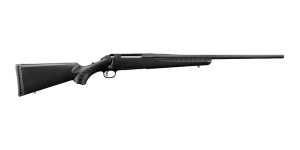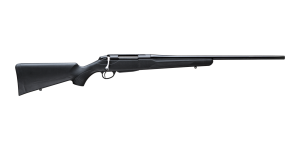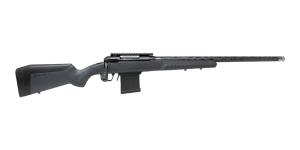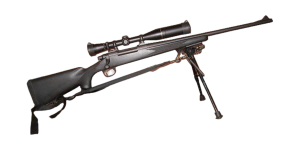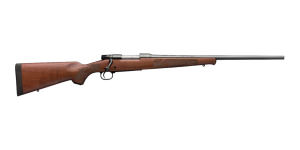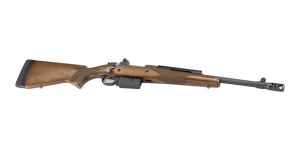
The best sling for a bolt action rifle is one that matches the interface your stock already has, which on most bolt-action hunting rifles means a pair of sling studs, front and rear. Everything else follows from that: the swivel has to fit the stud, the webbing has to suit the weight of the rifle, and the whole assembly has to stay put without changing where the rifle shoots.
Check your own rifle before you buy anything. Stud presence, stud type and stock material vary enormously across bolt guns, and the wrong assumption costs you either a return or a hole in a stock you did not want to drill.
Confirm the rifle is unloaded before fitting, removing or adjusting a sling. Bolt open or removed, magazine out or the floorplate dropped, look into the chamber and feel with a finger. Sling work means the rifle gets rotated, held upside down and rested on a bench while your hands are on webbing and screws, and that is exactly when muzzle discipline slips. Point it somewhere safe for the whole job.
The sling stud is the standard interface
A sling stud is a small threaded post with a cross-hole through it, screwed into the stock so the hole sits parallel to the bore. A swivel drops over the stud and a pin passes through that cross-hole, capturing the swivel. Most bolt-action hunting rifles ship with two, one under the fore-end and one on the underside of the buttstock, though there is no universal rule and you should look at yours rather than assume.
This is a very different world from modern sporting rifles, which use M-LOK slots, QD sockets and end plates, covered in our post on AR-15 sling attachment points. The two systems do not interchange without an adapter. A stud is older and simpler: small, snag-free, cheap, and standard for so long that swivel availability is never a problem.
What a stud is not is a load-rated engineering fitting. It is a wood screw or a machine screw into a stock, and the strength of the joint is the strength of the material it is threaded into, not the stud itself. That single fact drives most of what follows.

Swivel types that fit a stud
Three families of swivel show up on stud-equipped rifles, and they are not equally good.
A fixed loop swivel is the simple one: a metal loop with a barrel and a captive pin that you push through the stud and lock. Once it is on, it stays on until you deliberately take it off. It is the strongest and the quietest, and it is what you want if you never intend to remove the sling.
A quick detach push button swivel uses a spring-loaded plunger so the swivel can be popped off the stud with a thumb. Note that this is a different mechanism from the QD sockets used on modern rifles, even though both get called QD. It lets you strip the sling off for a bench session or for transport in a case. The trade-off is a spring and a detent that can wear, and a button that can be pressed by accident against a pack or a truck seat.
An older thumbscrew or knurled-nut swivel tightens onto the stud by hand rather than latching. They work, but they loosen with vibration and with the rifle rubbing on clothing, and they are the most likely of the three to be found hanging by one side at the end of a day. Check them every time you pick the rifle up.
| Swivel type | How it attaches | Best for | Watch out for |
|---|---|---|---|
| Fixed loop | Captive pin through the stud, locked | A sling that lives on the rifle | Slow to remove, needs a tool or fiddling |
| Quick detach push button | Spring plunger latches into the stud hole | Rifles that go in and out of cases | Accidental release, spring and detent wear |
| Thumbscrew or knurled nut | Threaded onto the stud by hand | Legacy rifles and vintage slings | Works loose with vibration, check often |
| Stud to socket adapter | Screws into the stud hole, accepts a modern QD swivel | Running one modern sling across several rifles | Adds a joint, and the joint is the weak point |
| Any of the above, checked before the season | Screwdriver and thirty seconds | Everyone | Studs back out of stocks slowly and silently |
Scroll the table sideways to see every column.
Fixed loop
- Strongest and simplest, nothing to fail
- Silent, no spring or detent to click
- Cannot release by accident in the field
- Slow to take off when you want the sling gone
Quick detach push button
- Sling off the rifle in a second, both ends
- Convenient for cases, benches and blinds
- A spring is a wear part and it lives in the weather
- The button can be pressed by a pack strap
Wood stocks, synthetic stocks and how studs anchor
How the stud is held is the part nobody thinks about until a swivel pulls out with a rifle attached to it.
In a wood stock, a stud is usually a wood screw threaded straight into the walnut or birch, sometimes into a pilot hole with no reinforcement at all. That joint is only as good as the wood around it. End grain, an old crack, a repaired stock or a stock that has been wet repeatedly will all hold worse than they look. Wood also moves with humidity, so a stud that was tight in autumn can be slightly loose in spring.
In a synthetic stock, it depends entirely on how the stock was built. A good one has a moulded-in insert, a metal pillar or a solid resin boss at the stud location, and the stud threads into that. A cheap one is a hollow shell with a thin skin, and a stud threaded into that skin is holding on to almost nothing. Some hollow stocks are foam filled, which is better than air but is not structure.
Laminated stocks generally hold studs well because the glued layers resist splitting. Chassis systems and aluminium bedding blocks usually skip studs entirely in favour of machined sockets or accessory rails, which is a different conversation.
The practical test is simple and costs nothing. Grip the swivel and pull hard, in line with how a sling would load it and then at an angle. Then check the stud with a screwdriver or the correct tool. If it turns, back it out, look at what is in the hole, and deal with it before you carry the rifle anywhere.
Adding a stud where there is none
Plenty of rifles have one stud, or none, or a rear stud and nothing up front. Adding one is sometimes a fifteen-minute job and sometimes a job for a gunsmith, and telling the two apart matters.
On a plain wood stock with plenty of material under the fore-end and nothing critical nearby, fitting a stud is drilling a correctly sized pilot hole, square to the surface, at the right depth, and threading the stud in. The risks are drilling through into the barrel channel, splitting the fore-end, or putting the hole off centre so the sling pulls crooked. All three are avoidable with care and a drill press or a jig, and all three are permanent if you get them wrong.
Send it to a gunsmith when any of the following is true. The stock is synthetic and you cannot tell what is behind the skin. The fore-end is thin, or the barrel channel is close. The stock is a laminate or a premium composite you do not want to gamble with. There is a bedding block, a chassis or an aluminium pillar in the way. The rifle is collectible, or the stock is figured wood you could not replace. Or you simply do not have a way to hold the stock square while you drill.
There are also non-drilling options worth knowing. Barrel-band studs clamp to the barrel and require no work on the stock, though they bring their own problem covered in the next section. Magazine-cap studs exist on some designs. And on rifles that accept them, a stud-to-socket adapter lets a single stud serve a modern sling. If you are working the same problem on a scattergun, our post on the shotgun sling swivel covers the shotgun equivalents, and shotgun sling swivel mounts covers clamp-on and cap-mounted options in more depth.
Barrel-band studs and point of impact
A front stud on a barrel band, rather than in the stock, is a tempting fix because it needs no drilling. It is also the one attachment choice on a bolt gun that can move your groups, and the reason is worth understanding rather than memorising.
If the barrel is free floated, it does not touch the stock along its length, and it vibrates the same way shot to shot. That consistency is where accuracy comes from. Hang a sling from the barrel and pull on it, whether from a shooting loop or just from the weight of a carried rifle in an odd position, and you are applying a bending load directly to the barrel. The barrel flexes slightly, the harmonics change, and the group moves. On a non-free-floated barrel that contacts the stock, the same tension also changes how hard the barrel presses against that contact point, which changes the vibration in a different but equally real way.
The effect varies by rifle, by barrel contour and by how much tension you apply. A light carry sling on a heavy barrel may show nothing measurable. A tight shooting loop on a thin sporter barrel can move impacts enough to matter at range. The point is not that barrel bands are forbidden, it is that you cannot assume the rifle shoots the same with the sling loaded as it did off a bag.
The fix is testing, not theory. Shoot your normal group off a rest with no sling tension, then shoot the same group with the sling under the tension you would actually use, and compare. If they overlap, carry on. If they do not, either move the front attachment to the stock or accept that the sling comes off for the shot. Either way, re-confirm your zero after you change anything about the front attachment, using the process in our guide on how to sight in a rifle.

Webbing width, padding and rifle weight
Sling width is a trade between comfort and bulk, and the right answer depends on what you hang from it.
A wider sling spreads the load over more of your shoulder, so it feels lighter over distance. That is why heavy magnum rifles, rifles with big optics, and anything you carry all day tend to get wide webbing or a padded shoulder section. The cost is bulk. Wide webbing sits proud of the rifle, catches on brush and pack straps, adds weight of its own, and can be awkward to use as a shooting support because there is more material to manage.
A narrower sling is lighter, lower profile and gets out of the way, which is what you want on a lightweight mountain rifle where every ounce was already argued over. On a rifle that light, the shoulder comfort argument mostly disappears, because the load is small. Carry that same narrow sling under a heavy rifle and you will feel the edge of the webbing after a few miles.
Padding is a separate variable from width. A pad can give you the comfort of a wide sling on a narrower strap, at the cost of the pad sliding and of extra thickness under a pack strap. Neoprene grips well and gets hot. Leather is quiet and durable and stretches when wet. Synthetic webbing is the most stable dimensionally.
Whatever the width, the things that actually break are the hardware and the adjuster, not the strap. Metal hardware survives being knocked against rock and frozen; plastic hardware is fine until it is very cold and then it is a gamble. The McLean Dynamic Retention Sling uses maritime grade webbing and all metal hardware with a patented two-point to one-point conversion, and it comes in Black, Coyote Brown, MultiCam and Ranger Green. It was designed by an Active Duty SOF operator and holds a 4.92 average from 169 reviews.

Fitting and checking the sling
- Clear the rifle first
Bolt open or out, magazine empty and removed, chamber checked by eye and by finger. Set the rifle on a bench with the muzzle pointing somewhere safe and leave it that way for the whole job.
- Check the studs before the swivels
Snug each stud with the correct tool. If one turns freely, stop and find out why. A stud that spins in wood needs the hole assessed, not more torque. Over-tightening splits fore-ends.
- Fit the swivels and load them
Attach both swivels, then pull hard on each in line and at an angle. Any movement, click or creak from the stock is a reason to stop. Better to find it on a bench than on a sidehill.
- Set the length for a shoulder carry first
Adjust so the rifle hangs on your shoulder without your hand on it, muzzle clear of the ground and clear of your own head. That is your baseline. Note where the adjuster sits so you can return to it.
- Check the length against your carry positions
Try each carry you actually use and confirm the sling reaches. Our post on how to carry a rifle while hunting covers the four positions and the muzzle arc each one creates.
- Verify zero after any change to the front attachment
Moving the front point, especially onto a barrel band, can shift point of impact. Shoot a group before you trust it, with and without sling tension.
A sling you can adjust one-handed matters more on a hunting rifle than people expect, because you change length constantly between the walk in, the stalk and the pack out. Our guide to a quick adjustable rifle sling explains what to look for in the adjuster itself. If you are carrying with a loaded pack, the routing question is covered in backpack rifle carry versus sling carry, and for the hardware itself see our quick detach sling mounts.
Frequently asked questions
Do all bolt-action rifles have sling studs?
No. Most bolt-action hunting rifles ship with a front and rear stud, but plenty do not, and some have only one. Target rifles, chassis rifles and some entry-level models handle attachment differently or leave it to you. Look at your own rifle before ordering swivels.
Can I put a sling stud in a synthetic stock myself?
Only if you know what is behind the skin. A synthetic stock with a moulded insert or a solid boss at that location takes a stud fine. A hollow shell does not, and a stud threaded into a thin skin will eventually pull out under load. If you cannot confirm what is in there, that is a gunsmith job.
Will a sling change where my rifle shoots?
It can, if the front attachment is on the barrel rather than the stock. Sling tension bends the barrel slightly and changes its harmonics, which moves the group. How much depends on the rifle and how hard you pull. Test it: shoot a group with no sling tension and one with the tension you would actually use, and compare.
How wide should a sling be for a hunting rifle?
Wider for heavy rifles and long carries, narrower for lightweight mountain rifles where bulk and weight matter more than shoulder comfort. There is no single correct number, and a pad on a narrower sling is a legitimate middle path. Consider what it has to fit under too, because a wide sling under a pack strap is a lot of material on one shoulder.