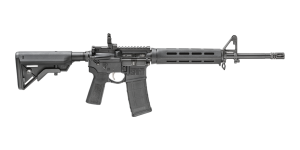
The best sling for AR15 rifles is the one that matches how you actually use the gun, and for most people that is a two-point with a fast adjuster. The question is not which brand. It is which layout, which mounting hardware, and which adjuster you can work one-handed without looking.
Work the decision in that order and the shortlist gets short fast. Start with the job the rifle does, then the mounts the rifle already has, then the sling itself.
Start with the job, not the sling
Slings get bought backwards. Somebody reads a spec sheet, picks a strap, bolts it on, and then discovers the rifle swings into their knees every time they kneel. The spec sheet was never going to tell them that. What the rifle does for you decides everything downstream.
Three questions cover almost every shooter. Do your hands leave the rifle while it is still on your body? Do you swap shoulders often enough that a slow transition costs you? Do you need the rifle completely off your body in a hurry? Answer those honestly, not aspirationally, and the layout picks itself.
A hunter walking timber, a patrol officer with a rifle in a rack, a competitor running stages, and somebody with one carbine for the house all get different answers. None of them is wrong. They just have different jobs.
The decision tree
Several of these questions are best answered with the rifle actually on your body. Remove the magazine, lock the bolt to the rear, and look and feel inside the chamber and magazine well to confirm both are empty before you fit or test anything.
- Do your hands leave the rifle while it stays on your body?
If yes, you need two attachment points. A single point lets the rifle pivot and swing the moment you stop holding it. Two points give it a fixed span to hang inside. This one question eliminates the one-point for most users on its own.
- Do you swap firing shoulders under time pressure?
If that happens constantly, a one-point buys you real speed. If it happens occasionally, a two-point with a quick adjuster covers it. Be honest about frequency here, because the swing you accept for that speed is with you all day, not just during the transition.
- Do you need the rifle off your body fast?
Getting into a vehicle, into a stand, onto a bench. If this is routine, you want quick-detach hardware at the attachment points regardless of layout, so the sling comes off the rifle or the rifle comes off the sling without unthreading anything.
- What mounting points does the rifle already have?
Existing sockets, M-LOK slots, a stock loop, a sling stud. This decides which sling ends will work and whether you need to add hardware. Sort this before you buy the strap, not after.
- Can you work the adjuster one-handed, blind, with gloves?
If the answer is no, nothing else about the sling matters. You will end up leaving it at one length permanently, which turns a shooting sling into a carry strap.
- Does the length range cover your real gear?
Set it wearing what you actually wear. A sling that fits over a t-shirt and binds over a plate carrier is the wrong sling, and you will not find that out on the couch.
Picking the best sling for AR15 use: layout by layout
| Layout | Hands-off stability | Transition speed | Load carry | Muzzle awareness needed |
|---|---|---|---|---|
| Two-point | High. Rifle stays where you put it | Moderate. One extra beat to swing over | Best. Spread across the torso | Low once the front point is set |
| One-point (loop) | Low. Rifle swings freely | Fastest | Poor. Load sits on one shoulder | High. Muzzle hangs and moves |
| One-point (H-harness) | Low. Still swings | Fastest | Better. Spread across both shoulders | High. Harness does not stop the swing |
| Three-point | Moderate | Slow. Webbing in the way | Moderate | Low |
| Convertible two-point | High in two-point mode | Fast once converted | Best in two-point mode | Low in two-point, high in one-point |
Scroll the table sideways to see every column.
Three-points are largely a legacy answer. They tangle, they cross the ejection port area with webbing, and they are slower than either of the layouts they were meant to combine. Very few people buy them new.
That leaves the real fight between two-point and one-point, and it is not close for general use. The two-point wins on the things you do all day and loses on the thing you do occasionally. That is why a convertible is the honest answer for shooters who genuinely need both. The McLean Dynamic Retention Sling uses a patented two-point-to-one-point conversion so you are not choosing once at purchase. It is built with maritime grade webbing and all metal hardware, comes in Black, Coyote Brown, MultiCam and Ranger Green, and was designed by a founder from the Active Duty SOF community. It averages 4.92 across 169 reviews.
Your mounting hardware decides half of it
People shop slings and ignore mounts, then find out the sling end does not fit anything on the rifle. Sort the attachment points first.
QD sockets and push-button swivels. The fastest way on and off. Sockets are added by end plates, M-LOK adapters and screw-in cups, so most are threaded installs and can work loose with use. QD is faster, not immune to loosening, and it deserves the same periodic wrench check as any other fastener. Its own distinct failure mode is the release button being pressed by gear, so face the button away from a plate carrier, a pack strap or a door edge. Start with quick detach sling mounts if the rifle has no sockets yet.
Webbing loops through handguard slots. No moving parts, nothing to fail, nothing to unclip. Cheapest option and a good one, as long as you never need the sling off in a hurry and the loop is seated in a slot that holds its position.
Sling studs. Standard on a lot of stocks and forends. Worth knowing that a spring-plunger stud swivel is itself quick-detach hardware, so this is not the permanently fixed option people assume. Studs concentrate load in a small screw, so check the screw and the swivel loop on a schedule.
If you want the sling and the hardware to arrive matched to the rifle instead of guessing, the kit builder pairs them up front.
What to check on the sling itself
Once layout and mounts are settled, the sling comparison comes down to four things.
Webbing. It needs to resist abrasion, hold its shape under load, and shed water without getting heavy or stiff. Webbing that stretches lets the rifle move even with the adjuster locked, which defeats the point of a tight setting.
Hardware material. Metal hardware takes impact and repeated load cycles better than plastic. Plastic hardware is lighter and quieter and is fine on a light rifle, but it is the part that breaks first when a rifle takes a fall.
Adjuster position. Test where the pull tab or lever sits when the sling is on the rifle and the rifle is on your body. If your support hand has to search for it, you will stop using it.
Stitching and load paths. Look at where the webbing turns around hardware. Bar tacks at every load-bearing junction, no raw cut edges, no single line of stitching carrying the whole rifle.
Color and pattern are the last decision, not the first. A sling that sits wrong in a color you love is still a sling you will replace.
Five mistakes that cost people a second sling
Crossing the attachment points. Front point on one side of the rifle, rear point on the other, forces a half twist into the webbing that no amount of adjusting removes. Both points go on the same side, or on the centerline.
Never moving the front point. Forward lengthens the span between attachment points, so the rifle rides more level and swings less. Rearward shortens it, so the rifle comes to the shoulder faster and sits tighter, but more barrel hangs past the front point and the muzzle rides lower. Try both before you decide the sling is the problem.
Setting length without gear on. Every measurement you take in a t-shirt is wrong the day you put a jacket or carrier on.
Assuming QD means maintenance free. Threaded sockets loosen. Check them.
Buying the layout you wish you needed. A one-point looks fast and feels tactical in the store. If your hands leave the rifle while it hangs on you, it is the wrong tool and you will find out in the parking lot.
For the deeper case on each side, read the two-point sling breakdown and the one-point sling breakdown, or work through the full AR-15 sling comparison.
Once you know which configuration you want, what separates good build quality from cheap covers what to look at before you spend. If the rifle is for the house, see the AR-15 home defense setup.
Frequently asked questions
What is the best sling for AR15 rifles if I only own one?
A two-point with a fast one-handed adjuster. It covers carry, movement and shooting support, which is most of what a general purpose rifle asks of a sling. If you also need one-point speed, a convertible gives you both without a second purchase.
Do I need padding?
Only for heavy rifles carried long distances. Padding adds bulk, can slow the adjuster, and does less for comfort than a correctly set two-point already does by spreading the load across your torso.
Should I buy quick-detach hardware or webbing loops?
Quick-detach if you routinely take the rifle off the sling, get into vehicles, or share the sling between rifles. Loops if the sling lives on one gun and you value having nothing that can be released by accident.
Is a one-point ever the right answer?
Yes, when you swap shoulders constantly or work in tight spaces where the rifle needs to move freely and come off your body fast. Accept that the rifle will swing and that muzzle direction becomes something you manage actively.
How do I know the sling is long enough?
Put on your real gear, set the sling loose, and check that the rifle hangs clear of your body with your hands free. Then cinch it short and check the rifle cannot move against your chest. If either end of that range is out of reach, the sling is wrong for your setup.
Does sling color matter?
Only for matching the rest of your kit. Function comes from layout, adjuster and hardware. Pick those first, then pick the color you want to look at.